Show-critical software · RF

FreqShow

A fleet of RF sensors watching the whole spectrum, all the time — and screaming the moment something shows up that shouldn't be there.

Distributed, coordination-aware wireless-mic & RF interference monitoring for arenas, convention centers and live events. Built in the trenches by techs who've been on the gig.

The analyzer

Know your RF. Catch the bogey.

Import your coordination and FreqShow knows every frequency that's supposed to be live. Anything else gets pulled out of the noise and flagged red — with an alarm you can see across the room.

keynote.eighty32.local — FreqShow Analyzer
Live · coordination-aware

A threat detector, not a peak finder.

Every node sweeps the entire band continuously. Coordinated carriers are masked from your import; anything uncoordinated lights up red with a pulsing, audible alarm.

  • Whole-band watch — alarms fire even while you're zoomed into one channel.
  • CFAR detection pulls a rogue low-power carrier out from in front of a 6 MHz DTV station and broadband hash — the wide stuff is just the real backdrop.
  • Live trace + waterfall, peak table, markers, drag-to-zoom, CSV export.
SoundBase import

Drop in your coordination. It does the rest.

Import a SoundBase PDF or CSV and FreqShow parses every operator, frequency and zone — then routes each channel to the node watching that area. The masked set updates instantly.

  • PDF & CSV parsing of standard coordination exports.
  • Operator → frequency → area routing per node.
  • Coordinated carriers go green; everything else is a candidate bogey.
FreqShow — Import · SoundBase
Locate

Don't just detect it. Walk to it.

When a bogey appears, every node that can hear it reports signal strength. FreqShow trilaterates the source across the floor so you know which room to walk into — before it steps on the show.

FreqShow — Beta · RSSI Locator
RSSI trilateration

Pythagoras on the RF floor.

Per-node signal strength becomes distance; distances become a position. The crosshair converges on the transmitter and gives you a room, not just a frequency.

  • Multi-node RSSI fused into an X/Y fix.
  • Confidence ring tightens as more nodes hear it.
  • Reads out zone + bearing so you can move.
Demod & listen

Hear what it is.

Tune any carrier and FreqShow streams the demodulated audio straight to your browser — NBFM or wideband — with a live level meter. Tell a hot mic from a comms link from a vendor's playback in seconds.

  • Browser audio — no extra app, streams from the node.
  • NBFM / WFM with correct pitch and a live meter.
  • Sweep pauses to listen, resumes when you're done.
FreqShow — Beta · Demod Listen
Alerts

It texts you before you'd ever see it.

You can't stare at a screen all night. When an uncoordinated carrier holds, FreqShow texts the responsible staff with the room, frequency, level and nearest coordinated channel — then texts ALL CLEAR when it's gone.

SMS · per-room context

The whole story in one text.

Room, frequency, level over threshold, and the nearest coordinated carrier so the recipient knows instantly whether it matters. Per-room cooldown means no spam.

  • Who's responsible for that zone gets the text.
  • ALL CLEAR auto-sends when the carrier drops.
  • Cooldown & coordination-aware — only real threats.
Node vs node

One picture isn't enough.

Overlay any two sensors to see how the RF changes from the keynote room to the breakout to the loading dock. The same carrier strong on one node and weak on another tells you where it lives.

  • Two-node overlay with per-node color & legend.
  • Scales to 50+ labeled nodes across a venue.
  • Spot a bogey that only one room can hear.
FreqShow — Compare · Keynote ⇄ Breakout
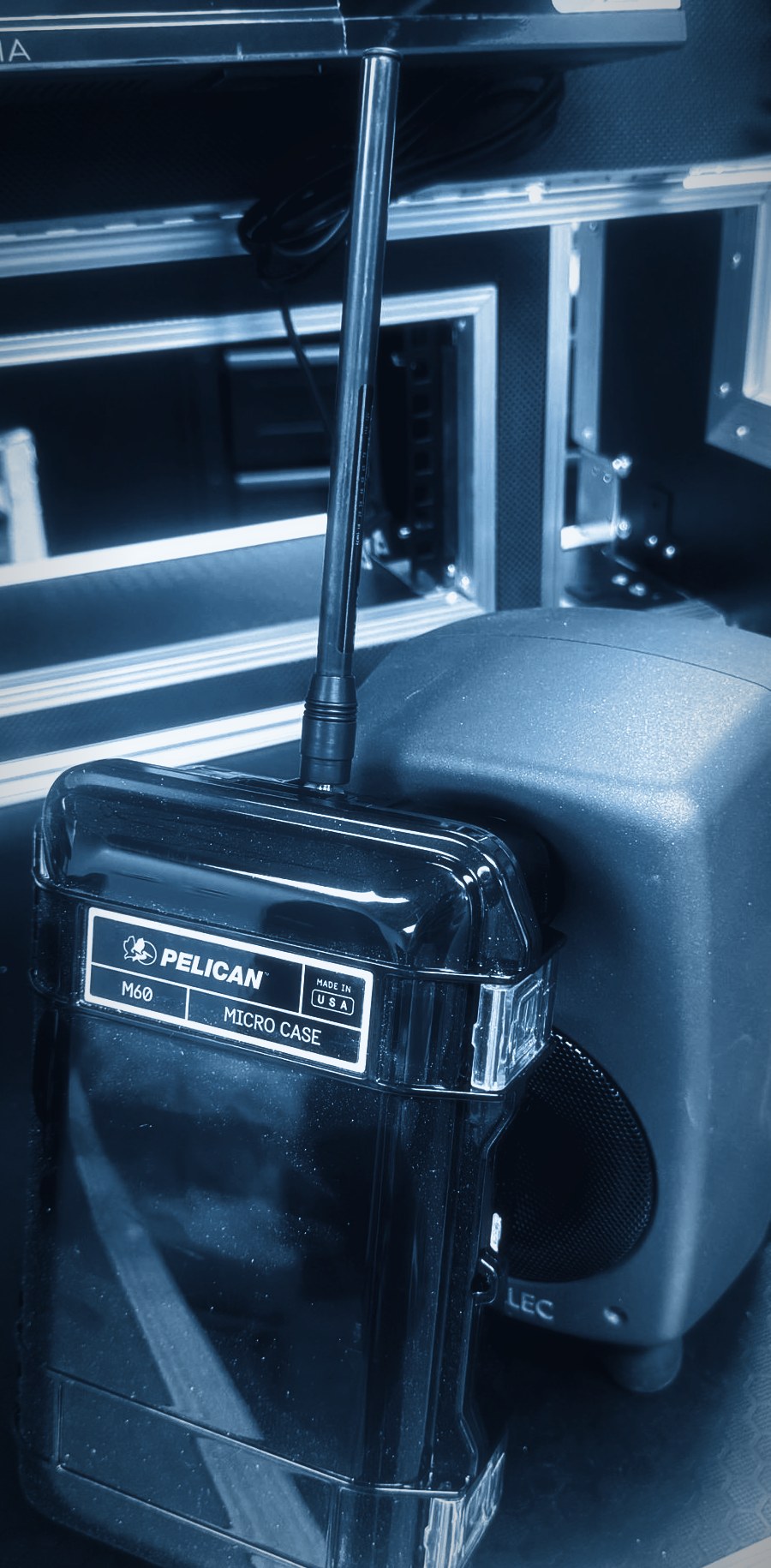
eighty32 FreqShow node — Pelican M60 case with SDR and whip antenna, leaning on a Genelec monitor
The hardware

A node you can throw in a workbox.

Each sensor is a Raspberry Pi, an SDR and a whip antenna in a rugged Pelican M60 — touring-grade and self-contained. Drop it on a truss, a shelf or a road case; power it over PoE or a battery and it joins the fleet. (Shown leaning on a Genelec for scale.)

  • Pelican-cased — built for the road, not the lab bench.
  • PoE or battery — one cable, or none at all.
  • Self-provisioning — baked by the Toaster, power-on-and-live.
The Toaster

Deploy a sensor in 90 seconds.

No images to fiddle with, no terminal. Drop an SD card in the Toaster, name it, give it an IP and a location, and bake. Slot it into a Raspberry Pi, power on — it configures itself and joins the fleet.

Toaster — Bake a node card

Stop guessing what's on your spectrum.

FreqShow is in field testing now. Want it at your next show, or to talk deployment?